
Cash Bond vs. Surety Bond: Which One Fits Your Situation

A cash bond means paying the court the full bail amount out of pocket, refundable later minus fees. A surety bond means paying a bail agent a nonrefundable premium, typically around 10%, so the agent guarantees the rest. Cash preserves nothing but principal; surety preserves your cash for rent, groceries, and a lawyer.
TL;DR:
- A cash bond requires paying the full bail amount upfront, which is refundable at case end minus court fees, but locks up cash for months.
- A surety bond involves paying around 10% of the bail amount as a nonrefundable premium, with the bail agent guaranteeing the full sum to the court.
- Surety bonds often require collateral and a background check, but avoid waiting months for refund and preserve liquidity for legal and household expenses.
- If the defendant misses court, cash bonds are forfeited immediately, while surety bonds allow a grace period before pursuit of the indemnitor begins.
- Most families find surety bonds more practical for higher bail amounts, as they lower upfront costs and keep cash available for ongoing costs.
Table of Contents
- Surety vs Cash Bond: The Key Differences at a Glance
- What Is a Cash Bond and How Does It Work?
- What Is a Surety Bond and How Does It Work?
- What Do Bonds Actually Cost, and How Long Do Refunds Take?
- What Happens if Someone Misses Court?
- How Should a Family Decide Between Cash and Surety?
- How to Post Either Bond: What to Have Ready
- An Honest Take on the Cash-vs-Surety Decision
- How Carter Bail Bonds Makes the Surety Option Easier
- Sources
Surety vs Cash Bond: The Key Differences at a Glance
The choice comes down to what you can afford to lock up versus what you can afford to lose. A cash bond ties up 100% of the bail amount until the case ends. A surety bond costs a fraction of that upfront, but you never see that fraction again.
Here’s how the two stack up on the factors that actually matter to a family trying to get someone home tonight:
- Upfront cost: Cash requires the full bail amount; surety requires a premium, commonly near 10% in many jurisdictions, though rates can run 1% to 15% depending on the bond and state.
- Refundability: Cash is refundable at case closure, minus court fees or fines; surety premiums are gone the moment the bond is posted.
- Liability: With cash, whoever paid is on the hook for that deposit. With surety, the indemnitor (often a family member) guarantees the full bail amount if the defendant skips court.
- Approval speed: Cash needs no underwriting, just funds. Surety involves a background check, paperwork, and sometimes a co-signer.
- Best for: Cash suits lower bail amounts with cash on hand; surety suits higher bail amounts where preserving liquidity matters more than losing the premium.
Quick stat: Unbonded construction projects that default cost roughly 85% more to complete than bonded ones, a data point that shows why surety exists as a risk-transfer tool far beyond bail.
What Is a Cash Bond and How Does It Work?
A cash bond is a straight deposit. You hand the court the full bail amount, in cash, cashier’s check, or money order depending on the courthouse, and the court holds it until the case resolves. State judicial guidance describes this as the simplest bond structure: two parties, no bondsman, no middleman.
Here’s the process in practice:
- Confirm the exact bail amount and accepted payment methods with the jail or clerk’s office.
- Pay the full amount and keep the receipt. You’ll need it to claim the refund later.
- Wait for case resolution. Courts return the deposit minus fines, fees, or restitution owed.
The upside is simple: no interest paid to anyone, and you get most of it back. The downside is just as simple: that money sits frozen for months, unavailable for a defense attorney or rent.
What Is a Surety Bond and How Does It Work?
A surety bond, often called a bail bond, brings a third party into the deal: the bail agent. Instead of paying the court directly, you pay the bondsman a premium, and the bondsman posts the full bail on the defendant’s behalf. This creates a three-way relationship between the principal (the defendant), the obligee (the court), and the surety (the bonding company), with an indemnity agreement binding whoever signs for the defendant.
The premium is calculated as a percentage of total bail, commonly landing near 10% for bail-specific bonds, though the exact rate depends on your state’s regulatory cap. On a $10,000 bond, that might mean $1,000 to $1,200 out of pocket instead of $10,000.
- The indemnitor (usually a relative) may need to offer collateral, like a vehicle title or property, especially for large bonds.
- If the defendant skips court, the bondsman can pursue the indemnitor for the full bail amount, not just the premium.
- Underwriters vet the defendant’s flight risk before agreeing to write the bond, since surety companies manage default and recovery themselves rather than through insurance.
Pro Tip: Ask the bail agent exactly what collateral they’ll require before you sign anything. A collateral-light option can save you from putting a car title on the line for a modest bail amount.
What Do Bonds Actually Cost, and How Long Do Refunds Take?
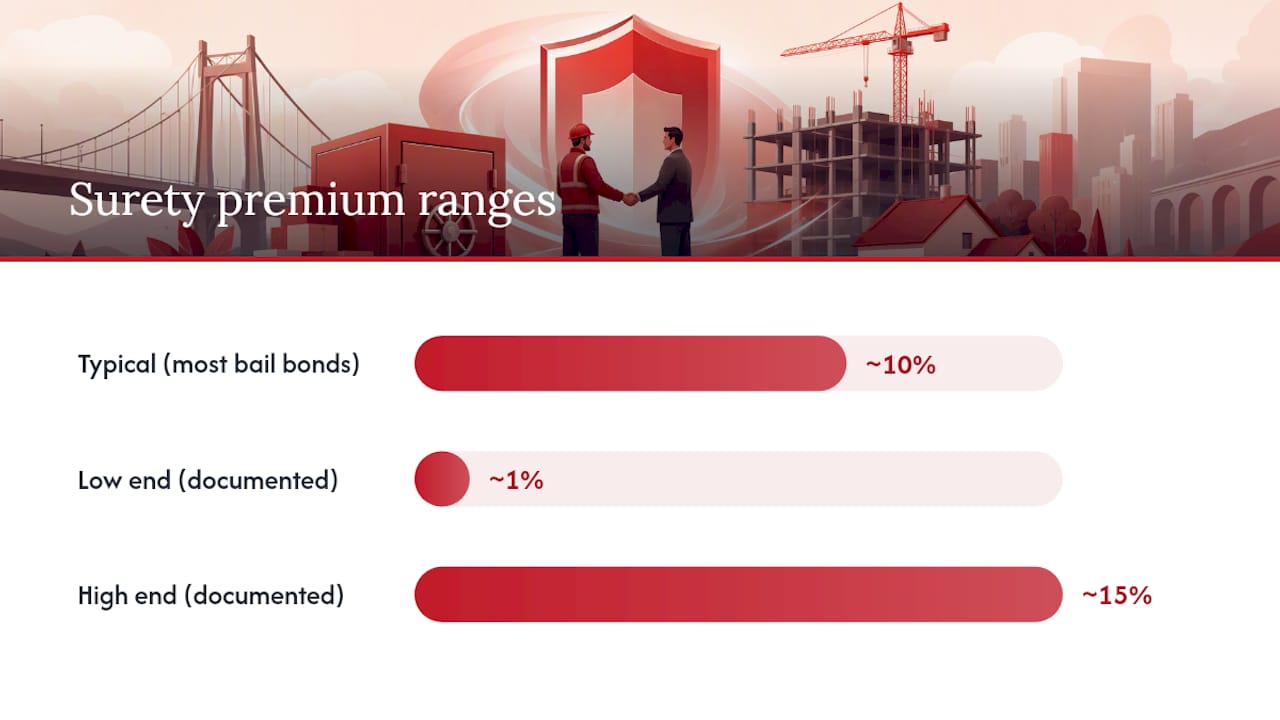
Premium ranges vary by state, bond type, and the defendant’s background, but most bail-specific surety premiums land close to 10%, with a documented range of roughly 1% to 15% across different bond categories. Factors that push the rate higher include prior failures to appear, out-of-state defendants, and higher perceived flight risk.
Cash refunds aren’t instant. Court refund timing varies widely, and families should expect anywhere from weeks to months, depending on caseload and how quickly the clerk processes the paperwork.
- Common deductions include court costs, unpaid fines, and restitution ordered by the judge.
- Surety bonds require no wait for a refund, because there’s no deposit to return.
- In business contexts, the SBA guarantees certain contract surety bonds for contractors, a reminder that surety is a mainstream financial tool, not just a bail mechanism.
A $5,000 cash bond held for four months costs you the use of that money, plus the risk of delayed refund. A $5,000 surety bond costs roughly $500 upfront and nothing more.
What Happens if Someone Misses Court?
Missing a court date triggers different consequences depending on which bond you posted. With a cash bond, the court can forfeit the full deposit immediately, and getting it back afterward is difficult even if the defendant later turns up.

With a surety bond, most sureties allow a short grace period to locate the defendant before the bond is formally forfeited. Once the surety pays the court, they pursue the indemnitor aggressively under the signed indemnity agreement, sometimes through a lawsuit or a lien against pledged collateral.
If a court date gets missed, act fast:
- Contact the court clerk immediately to understand forfeiture status.
- Call the bail agent before the grace period expires.
- Get legal counsel involved if collateral seizure or a collection lawsuit looks likely.
Read more on what to do next on Carter Bail Bonds’ failure to appear and missed court page.
How Should a Family Decide Between Cash and Surety?
Start with a simple checklist before you commit either way:
- Do you have the full bail amount sitting in liquid savings, with no other use for it? If yes, cash is worth considering.
- Will this case likely stretch for months? Longer timelines make locking up cash more painful.
- Do you need funds free for a defense attorney or daily expenses? Preserving liquidity for legal costs is often the deciding factor for families choosing surety.
- Can you tolerate losing a nonrefundable premium permanently? If not, weigh that against the opportunity cost of frozen cash.
Before signing with any bail agent, ask about the exact premium percentage, whether collateral is required, and what payment plans exist.
Pro Tip: If bail is under $1,000 and you have the cash sitting idle, a cash bond often makes more financial sense. Above that, most families find the premium worth the freed-up liquidity.
How to Post Either Bond: What to Have Ready
For a cash bond: bring valid photo ID, confirm who is authorized to post on the defendant’s behalf, and pay via the accepted method, cash, cashier’s check, or money order. Keep every receipt.
For a bail agent: provide the defendant’s full name, booking number, and charges, then sign the indemnity agreement. Discuss collateral and payment plan options upfront.
- Gather ID and case information (booking number, charges, jail location).
- Choose your path and complete payment or paperwork.
- Retain all receipts, signed agreements, and the agent’s contact information for your records.
An Honest Take on the Cash-vs-Surety Decision
Most guides treat this as a purely financial calculation, and mathematically, cash usually wins if you can afford it and don’t mind waiting. But in practice, the math misses the point. Families rarely have $10,000 sitting around that they can freeze for months without consequence. The real cost of a cash bond isn’t the deposit, it’s what you can’t do with that money while it’s locked up: hire a defense attorney, cover rent, keep the lights on.
Handling releases across Calcasieu Parish and the surrounding area has shown a consistent pattern: families who choose surety aren’t avoiding cost, they’re managing risk. A 12% premium capped by state regulation is a known, bounded loss. A frozen deposit is an unknown, open-ended one. Prison Policy Initiative’s data on pretrial detention underscores just how many families face this exact choice every day, often with no time to deliberate.
The nonrefundable premium stings. But for most families, keeping cash on hand for a lawyer beats getting a partial refund six months from now.
— Jake
How Carter Bail Bonds Makes the Surety Option Easier
Carter Bail Bonds is the direct path for families choosing a surety bond in Calcasieu Parish and Southwest Louisiana. Instead of freezing your savings for months waiting on a court refund, you pay a state-regulated premium capped at 12% and keep the rest of your money available for legal defense and household needs.
Every bond runs through a 24/7 live agent, so a late-night arrest doesn’t mean waiting until morning to start the release process. Flexible payment plans reduce the upfront hit, and collateral-light options mean many families never have to put a car title or property on the line. Local knowledge of the parish jail system also speeds up processing compared to agents working from outside the area.
If someone you love was just arrested, contact Carter Bail Bonds now to start the release process, or check your local coverage area, including Sulphur and Jennings, for direct contact details.
Sources
For deeper verification, the SFAA’s overview of surety’s economic value, the SBA’s guidance on contract surety bonds, and the Fiscal Service’s list of certified sureties all offer official context beyond bail. State-specific procedural questions are best confirmed directly with your local court clerk.
- Benefits of Surety – SFAA
- Benefits of Surety - NASBP
- Types of bonds — Colorado Judicial
- SBA guidance on surety bonds
- What is a cash bond vs a surety bond? — LegalClarity